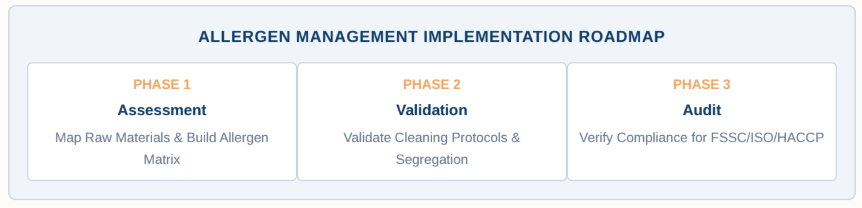
Attention: Malaysian food manufacturers, processors, exporters, QA managers, and food safety lead auditors. Undeclared food allergens remain a leading cause of global product recalls and audit non-conformances.
Managing food allergens is no longer just a labeling formality—it is a critical food safety pillar. With strict international requirements, food businesses operating in Malaysia and exporting worldwide must align their operational controls with the Codex Code of Practice on Food Allergen Management (CXC 80-2020) alongside regional regulations like Malaysia’s Food Regulations 1985, the US Big 9, and the EU 14 Allergens.
Whether you are pursuing or maintaining GMP, HACCP (MS 1480), ISO 22000, or FSSC 22000 certification, a robust Allergen Management System is mandatory. At Mindaflex, we equip food businesses with practical controls to eliminate cross-contact risks and maintain seamless compliance.
Why Allergen Management Is Critical for Certification Standards
Major certification bodies (SIRIM QAS, MOH, Lloyd’s, BSI, SGS) enforce strict allergen management protocols during audit surveillance. Here is how allergen control integrates into core standards:
- GMP (Good Manufacturing Practice): Establishes foundational Prerequisite Programs (PRPs), including dedicated storage, color-coded utensils, and line clearance to prevent allergen cross-contact.
- HACCP (MS 1480:2025): Demands rigorous hazard analysis of raw materials and packaging (Annex A) to identify allergen hazards and establish operational controls or CCPs.
- ISO 22000: Requires allergen hazard assessments within Prerequisite Programs (ISO/TS 22002-1) and mandates explicit verification of cleaning effectiveness.
- FSSC 22000 (Version 6): Features additional requirement 2.5.6 dedicated specifically to Allergen Management, mandating documented risk assessments, validation of cleaning procedures, and precautionary allergen labeling (PAL) justifications.
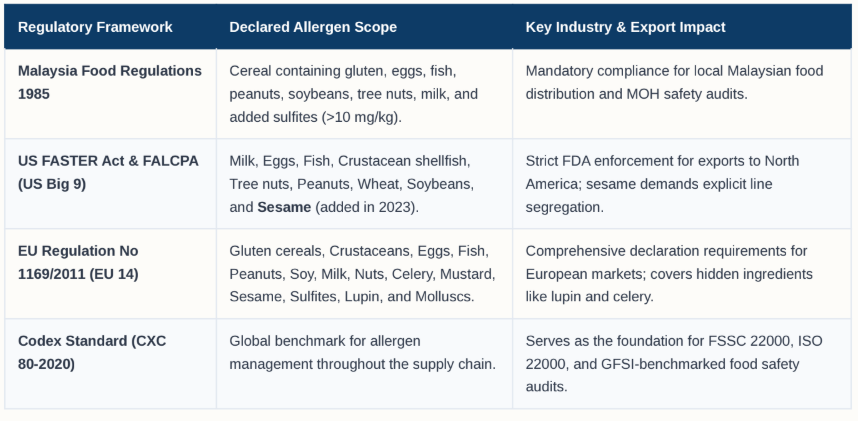
Comparing Global Allergen Regulations:
Malaysia vs. US Big 9 vs. EU 14
Your 4-Step Action Plan for Allergen Compliance
STEP 1 : Map All Inward Raw Materials & Packaging
Audit raw material specifications, supplier Certificates of Analysis (CoA), and secondary packaging to maintain an accurate Allergen Matrix across all production lines.
STEP 2 : Implement Cross-Contact Operational Controls
Enforce strict physical or temporal separation, color-coded utensils, dedicated staging areas, and validated line- clearance routines between allergen and non-allergen runs.
STEP 3 : Validate and Verify Cleaning Procedures
Routine visual inspection is insufficient. Perform quantitative analytical testing (e.g., ELISA kits or lateral flow devices) to scientifically validate cleaning protocols.
STEP 4 : Upskill & Train Your Food Safety Team
Train operators, hygiene personnel, and internal auditors on Codex principles, precautionary allergen labeling (PAL), and regulatory export compliance.